
Control light where systems reach their hardest limits.
Bandwidth, latency, precision, power, reach, and integration are driving photonics closer to compute, deeper into aerospace systems, and into the core of quantum information technology.
01 / AI interconnect
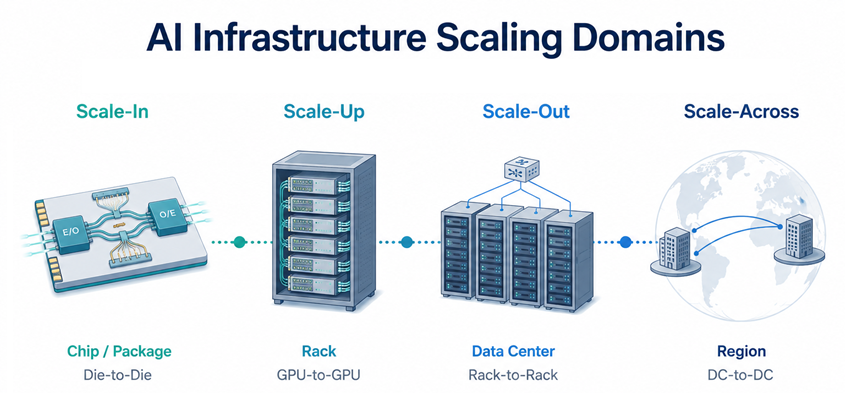
Photonics moves closer to compute.
As AI systems scale, electrical reach, power, and bandwidth become critical constraints. Integrated photonics enables high-bandwidth, energy-efficient connectivity from racks and clusters toward XPUs, packages, and chips.
Scale-out
Across racks and clusters
High-capacity optical connectivity supports conventional network-scale AI infrastructure and long-reach data movement.
Scale-up
Between XPUs
High-bandwidth, low-latency fabrics use TFLN, ELN™, SiPh, and SiN for modulation, routing, and integrated optical connectivity.
Scale-in
At chip and package level
Dense integration and optical I/O move connectivity inside the compute domain through integrated Tx/Rx and co-packaged optics.
TFLN
High-speed electro-optic devices
Strong, low-loss modulation for links approaching compute, including Mach–Zehnder, phase, and IQ modulation with development toward multichannel optical I/O.
SiPh
Integrated photonic devices
Modulators, Ge photodetectors, WDM functions, routing, and coupling combine toward compact Tx/Rx and optical-engine architectures.
SiN
Low-loss passive photonics
WDM, filtering, routing, and external-laser distribution manage optical signals across integrated systems and photonic interposers.
System objective: higher bandwidth through high-speed electro-optic modulation, denser integration through integrated devices, and lower loss through passive optical routing—including 800G/1.6T CPO modules, 64T optical-engine development, and high-density optical I/O.
02 / Space and aerospace
Navigation, communication, and sensing.
High bandwidth, precision, compact size, and immunity to electromagnetic interference make photonic systems essential for navigation, satellite networks, remote sensing, and demanding aerospace environments.
Navigation
Fiber-optic gyroscopes
FOGs deliver precise, reliable rotation sensing for navigation and attitude control with no moving parts and strong resistance to electromagnetic interference.
- LiNbO₃ MIOC
- Polarizer and Y-branch
- Integrated phase modulation
Communication
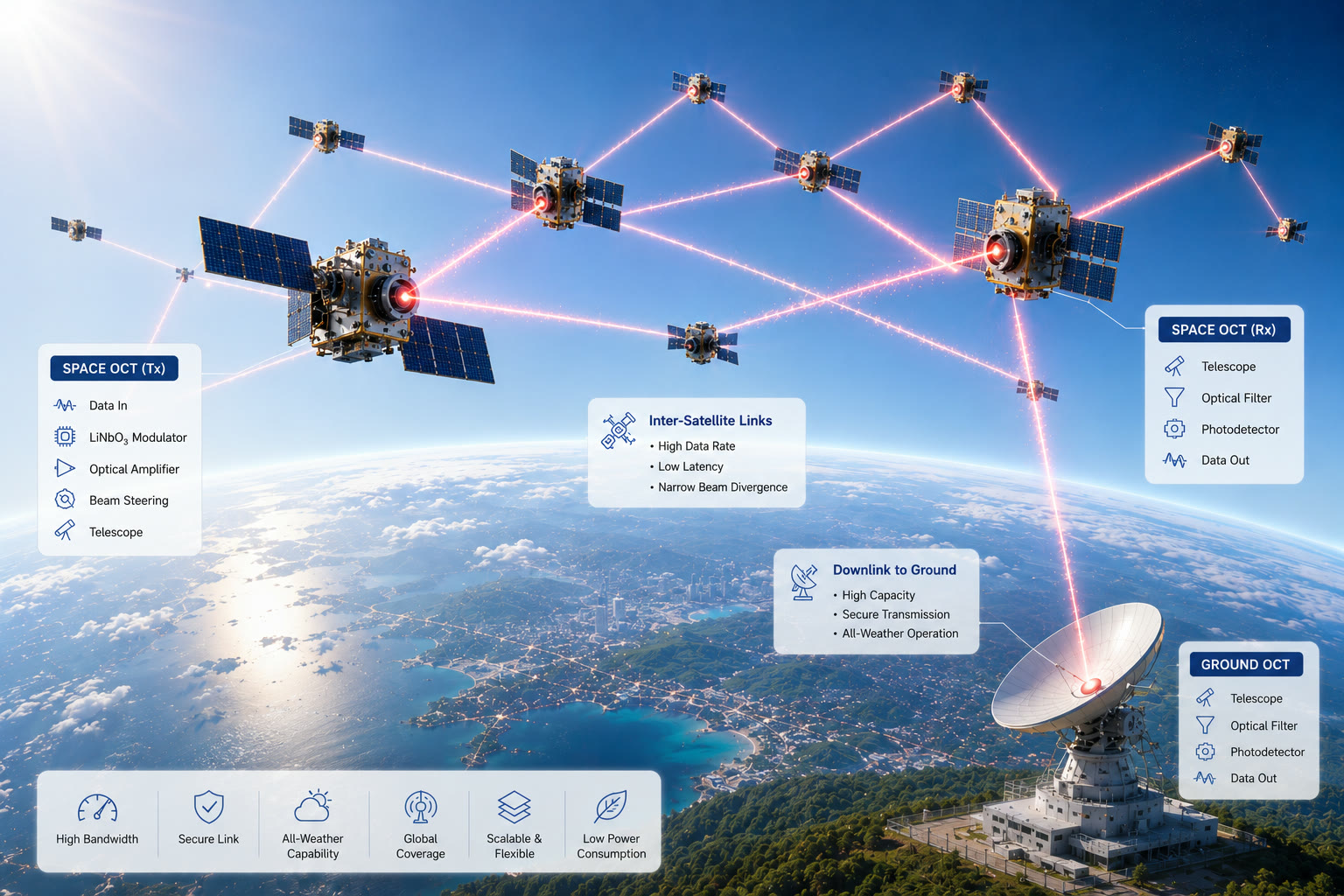
Optical communication terminals
High-speed, high-capacity inter-satellite and space-to-ground laser links use LN, ELN™, and TFLN modulation for multiple performance and integration levels.
- Coherent transmitter
- Ultra-wideband IQ modulator
- Phase control with zero chirp
Sensing
LiDAR
Fast optical modulation and control support precise ranging, mapping, motion measurement, and 3D sensing for aerospace and remote-sensing systems.
- Frequency control
- Phase modulation
- Higher photonic integration
MIOC
Multifunction integrated optical circuit
A polarizer, Y-branch splitter, and phase modulator on one chip for compact, high-precision interferometric fiber-optic gyroscopes.
IQ modulator
Coherent signal generation
A nested dual Mach–Zehnder structure independently controls I and Q for advanced coherent networks and space-based laser communication.
Coherent LiDAR
Precise optical control
LN, ELN™, and TFLN platforms supply high-speed modulation and field control for coherent ranging and velocity measurement.
03 / Quantum communication
From quantum light generation to detection.
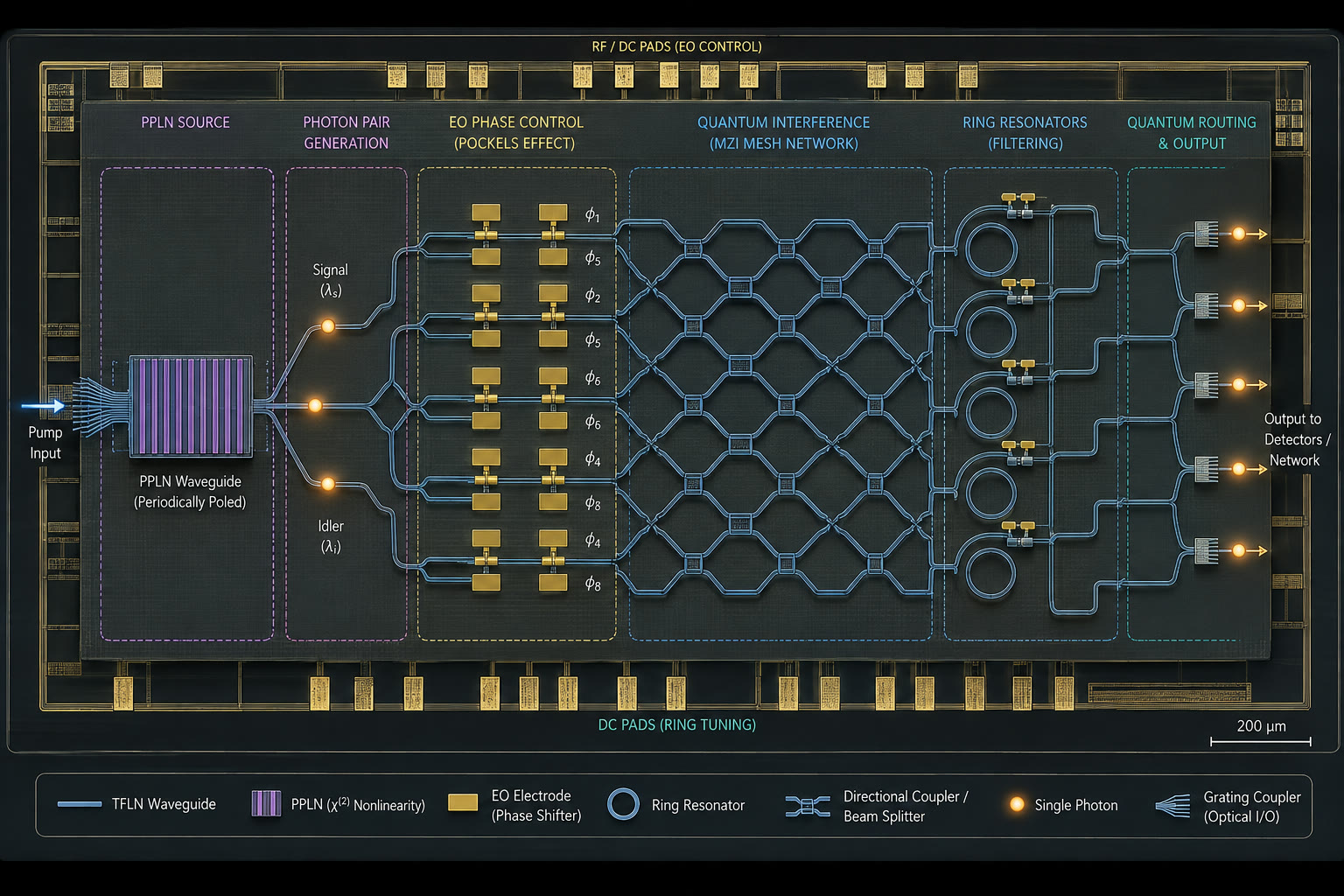
Quantum key distribution uses quantum states of light for secure key exchange. A complete photonic chain generates correlated photons, prepares and routes quantum states, and detects single-photon signals.
Generate
PPLN / SPDC sources
Spontaneous parametric down-conversion produces correlated or entangled photon pairs for quantum communication, with PPLN enabling efficient source generation.
Control
TFLN · ELN™ · SiN
Electro-optic modulation, phase control, programmable delay, and low-loss routing support flexible quantum-state preparation and manipulation.
Detect
SNSPD integration
Superconducting nanowire single-photon detectors provide high detection efficiency, low dark counts, and fast timing response.
04 / Photonic quantum computing
Build computation into the path of light.
Measurement-based quantum computing performs computation through adaptive measurements on an entangled photonic cluster state, using measurement results to control subsequent operations through photonic circuits and feed-forward control.
Resource
Single-photon generation
PPLN-based SPDC supplies single-photon and entangled-photon resources for photonic quantum computation.
Cluster state
SiN photonic circuits
Low-loss routing, interference, and programmable delay support the generation and manipulation of large-scale entangled photonic cluster states.
Measurement
TFLN / ELN™ control
Fast, precise phase control and reconfiguration enable adaptive measurements and feed-forward operations.
Integrated objective: combine quantum-light generation, low-loss optical processing, adaptive electro-optic control, and single-photon detection in increasingly integrated American photonic systems.